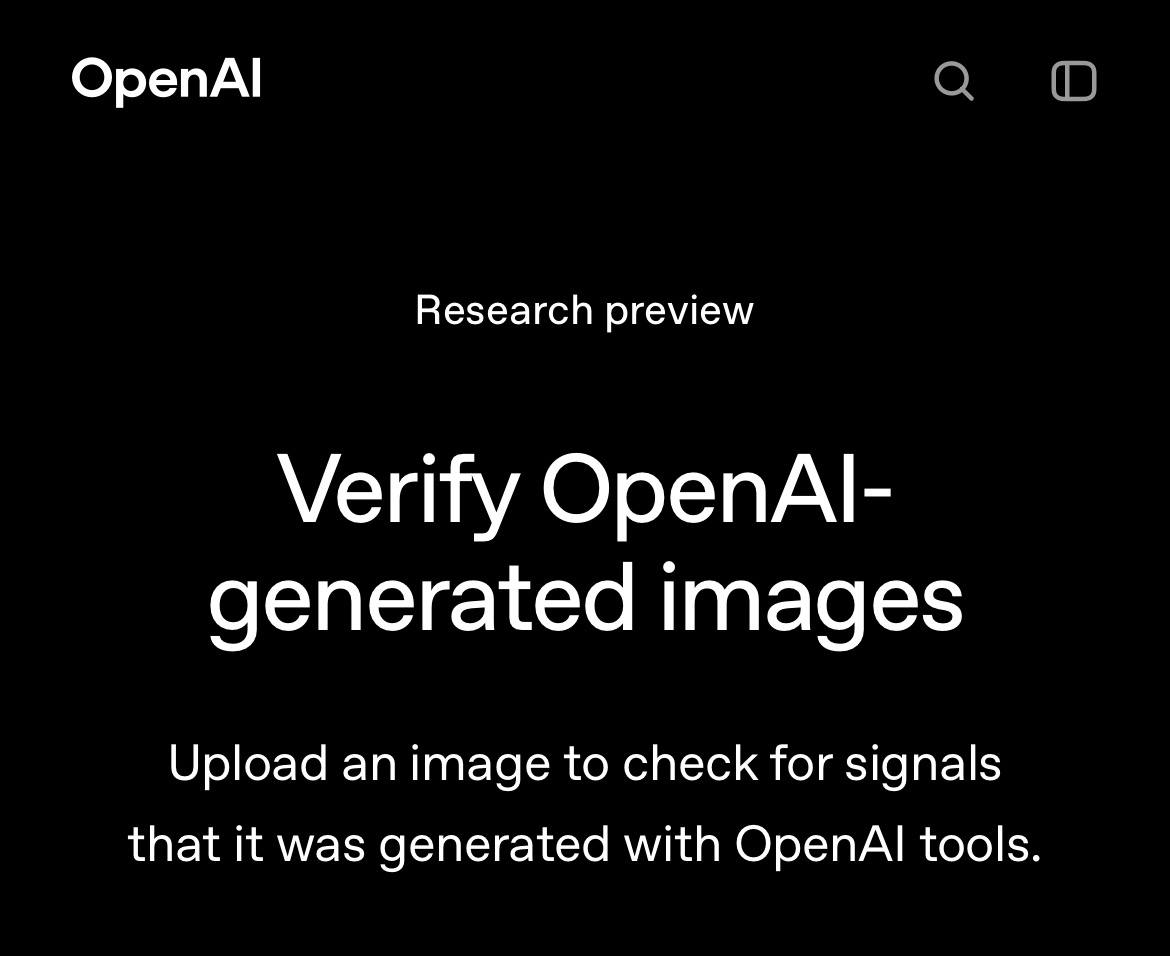
👀 On May 19 OpenAI quietly launched a tool that changes the rules for AI images. Upload any picture - and a few seconds later you know whether ChatGPT drew it or not.
What is Verify:
The tool is public and free. You open openai.com/verify, upload a file - and get a report: OpenAI markers or not. Starting May 19, 2026, every image created via ChatGPT, the OpenAI API and Codex automatically gets two invisible signals embedded in the image data. One is cryptographic in the metadata, the other is right in the pixels. No settings needed on the user's side
Two technologies under the hood:
📌 C2PA Content Credentials - cryptographically signed metadata with the source, the tool used to create it and a timestamp. An open standard: backed by Adobe, Microsoft, Google, Reuters, BBC and several hundred more organizations. Weakness: metadata can be stripped programmatically
📌 SynthID from Google DeepMind - invisible watermarks embedded right into the pixels. They survive screenshots, compression, cropping and format changes. That's exactly why the two technologies work as a pair: where one fails, the other takes over
OpenAI honestly admit it: errors are rare but possible. The main limitation today - Verify only sees images from OpenAI products. Upload a picture from Midjourney or Stable Diffusion - you'll get an empty result, and that doesn't mean it's not AI-made
What happens next with the ecosystem:
⚡️ Google Search and Chrome - getting ready to build native SynthID watermark detection right into the browser and search results
⚡️ Adobe via CAI - has been pushing C2PA as a global industry standard for years through a coalition with media, tech and camera makers
⚡️ The road to full coverage - only once the whole market adopts C2PA will detection stop being "just an OpenAI thing" and become a real infrastructure layer
💼 Verify is available for free at openai.com/verify - no sign-up, no limits
⭐️ Andy Parsons, Head of Content Authenticity Initiative, Adobe:
"Content credentials are like an ingredients label on a product. Only not for food, but for digital content: you instantly see who made it, with what tool and when"
💭 OpenAI made Verify a free public tool - they're not monetizing it, they're building trust infrastructure. The weak spot is obvious: for now it only works for pictures from OpenAI itself. But the direction is clear - once Google builds detection right into Search, images without metadata will start raising suspicion automatically. The logic will flip: not "found a marker - so it's AI", but "no marker - so something's off here" 👀