

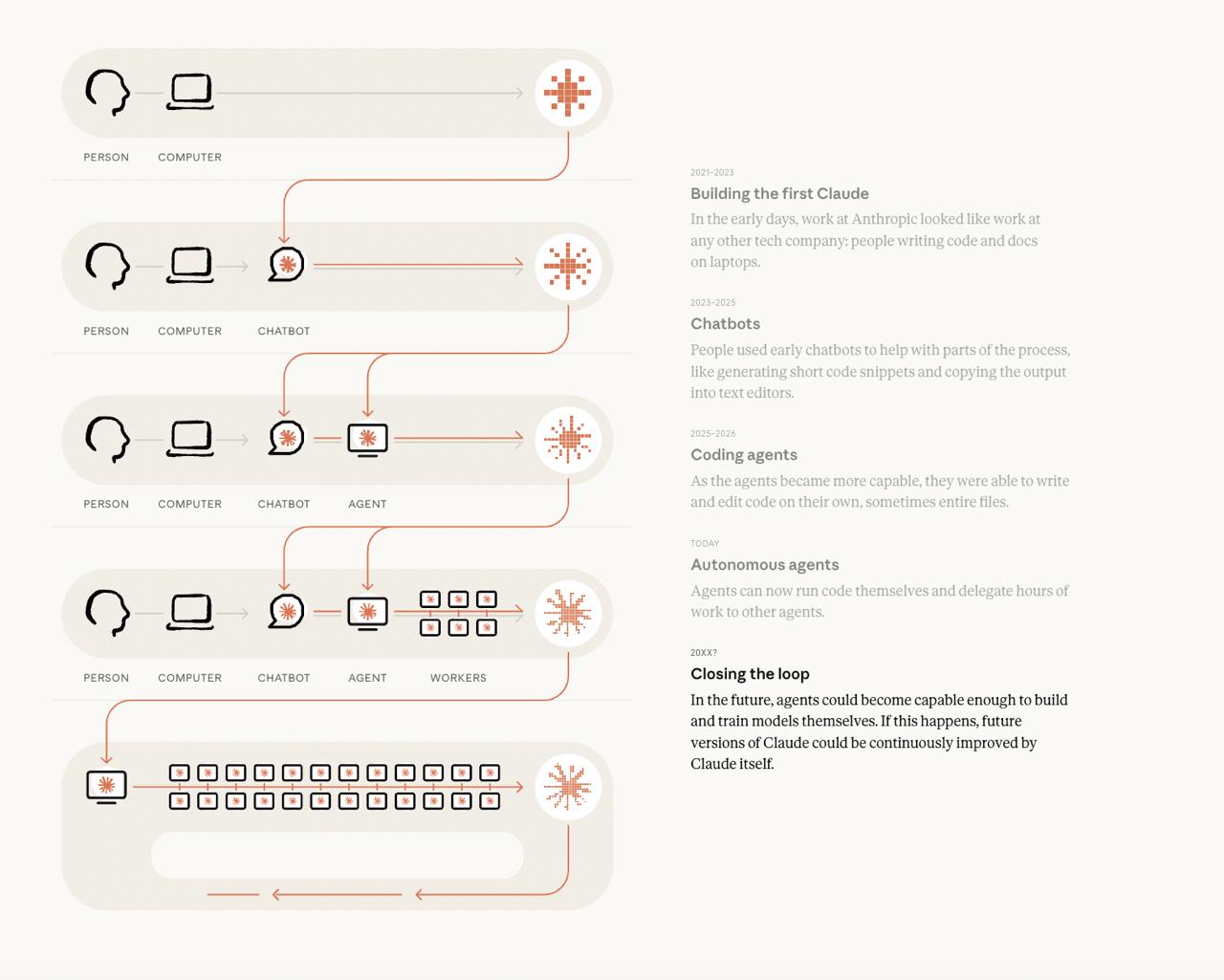
🔥 Anthropic disclosed internal stats that change the very idea of a "dev team". As of May 2026, Claude writes more than 80% of the company's code that makes it into production. In early 2025 that share was almost zero. Development speed is up 8x - and an unexpected bottleneck has appeared
Details of the official disclosure from CEO Dario Amodei:
Engineers ship 8x more code per quarter compared to the 2021-2025 baseline. All that speed runs into a new bottleneck - people physically can't keep up with reviewing the volume of code AI generates. A telling case: in April 2026 one engineer set Claude loose on a class of API errors. Claude autonomously shipped 800+ fixes and cut the error rate 1000x. By the engineer's own estimate - the same work would have taken a human 4 years. Claude's success rate on complex open-ended engineering tasks rose to 76% by May - up 50 percentage points in 6 months
The new reality in numbers:
📌 80% of production code is written by Claude - in early 2025 it was almost 0%
📌 8x faster development per engineer per quarter vs the 2021-2025 baseline
📌 52x speedup on code optimization benchmarks; the best engineer gets only 4x in 4-8 hours
When code generation outpaces review - the bottleneck shifts. Anthropic's answer was predictable: they started using Claude for review too. In March 2026 they launched the multi-agent Claude Code Review - whenever a PR is opened, several specialized agents check architecture, security and regressions in parallel. Each agent covers its own aspect independently
Claude Code Review - what the internal analytics say:
💻 Share of PRs with comments went from 16% to 54% after rollout
💻 False positives under 1% - review quality holds up
💻 ~1/3 of past incidents on claude.ai could have been prevented by the reviewer in advance
💻 800+ autonomous fixes in one run - error rate down 1000x. The supervising engineer estimated the same work at 4 years for a human
My answer on accountability
I run 8 Claude Code agents every day, and AI writes almost all of my system's code too. So the question of who answers for a mistake isn't theoretical for me; it comes up daily. My answer is simple: the person who set the task and pressed yes is accountable. AI can write and check, but the final word on any action that can't be undone stays with a person
In practice it's written into rules. My personal agent Jes, running for 134 days, has deleting data, spending money, messaging clients and publishing always wait for my yes. In the content factory a post can pass the fact check, but it won't go out without my button: 84 posts have been published this way, none without approval. At the clinic the bot leads a conversation to a booking, but the booking itself appears only after the doctor confirms it
How to keep a mistake from repeating
Answering for a mistake isn't enough; it must not happen again. After each of my corrections the agent writes itself a new rule and follows it next time. That's the closed loop, just with a person inside: AI writes, AI checks, a person decides and teaches. Take the person out of the loop and accountability doesn't disappear; it just becomes nobody's
Advice for your own system: for every action, write down in advance who confirms it. If there's no such person, it's too early to trust that action to an agent. Start with actions that are easy to undo: a draft, a reminder, a summary
💭 The loop is closed: Claude writes the code - and Claude reviews that same code. At the company that builds it. This is no longer a conversation about "the future of development" - it's the current production process. The next question that genuinely interests me: what happens to accountability when the bug was written by AI, reviewed by AI, and shipped to production by AI too?